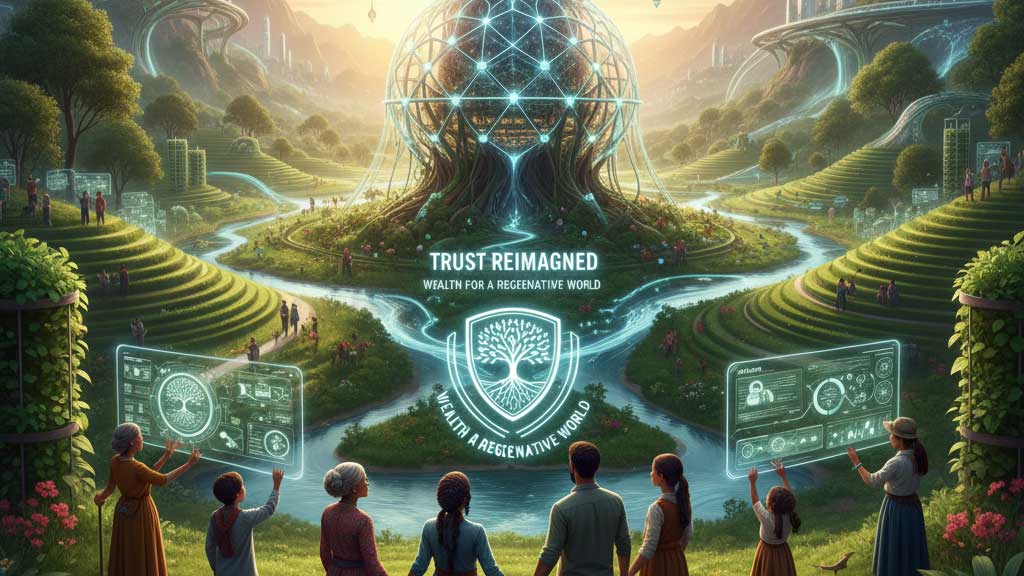
When Trust Becomes Infrastructure
ZenTrust Team • 12/4/2025 • 3 min read
When You Zoom Out, a Pattern Appears
Across societies and economies, trust tends to erode not because people suddenly become less ethical, but because systems scale faster than relationships.
As financial systems grow larger and more complex, decision-making often becomes distant from the communities and ecosystems affected by those decisions. Over time, trust shifts from something lived and relational to something abstract and contractual.
When this happens, wealth may continue to grow — but confidence, legitimacy, and long-term resilience begin to decline.
Trust Is Not a Belief. It Is a Design Outcome.
Trust is often discussed as a moral quality or a personal virtue.
But at scale, trust behaves more like infrastructure.
It emerges when systems are:
* transparent in how decisions are made
* accountable to those impacted
* aligned with long-term consequences rather than short-term extraction
When these conditions weaken, trust does not disappear mysteriously — it degrades predictably.
Wealth Follows the Rules It Is Given
Capital is not inherently extractive or regenerative.
It behaves according to the structures that guide it.
When financial systems reward speed, opacity, and short-term return, value concentrates quickly and disconnects from place, people, and ecology.
When systems reward stewardship, patience, and feedback from real-world outcomes, capital tends to circulate more evenly and support lasting value creation.
The difference is not intention.
It is architecture.
From Accumulation to Stewardship
Living systems offer a useful reference point.
Healthy ecosystems do not maximize storage at a single node. They circulate nutrients, energy, and information continuously. Resilience emerges from flow, not hoarding.
When applied to human systems, this insight reframes wealth:
* not as something to be endlessly accumulated
* but as something entrusted, guided, and returned to circulation
Stewardship, in this sense, is not a moral claim — it is a functional requirement for durability.
Regenerative Capital in Practice
ZenTrust’s work is informed by this systems perspective.
Rather than treating trust as a marketing signal or wealth as an end in itself, programs are structured so that:
* capital is deployed into regenerative agriculture, ecological restoration, and integrative wellness
* decision-making remains transparent and accountable
* outcomes are measured over time, not just at the point of investment
Tools such as Program-Related Investments (PRIs) allow capital to support public-benefit projects while remaining aligned with long-term ecological and social health.
In these models, trust is not assumed.
It is continuously produced by how the system operates.
Why This Matters Now
Periods of rapid change tend to expose weak institutional design.
As ecological stress, social fragmentation, and financial volatility increase, systems built purely for extraction struggle to adapt.
Systems designed for stewardship — where trust is reinforced by structure rather than rhetoric — tend to endure longer and fail more gracefully.
The future of wealth is not determined by how much capital exists, but by how deliberately it is designed to move.
Trust as a Living System
When trust is treated as infrastructure rather than sentiment, new possibilities open:
* capital can support regeneration rather than depletion
* communities can participate without being overexposed
* ecosystems can recover while remaining productive
In this light, reimagining trust is not idealism.
It is systems engineering for a world that must last.